

Goat LP is experimental. Use small amounts.
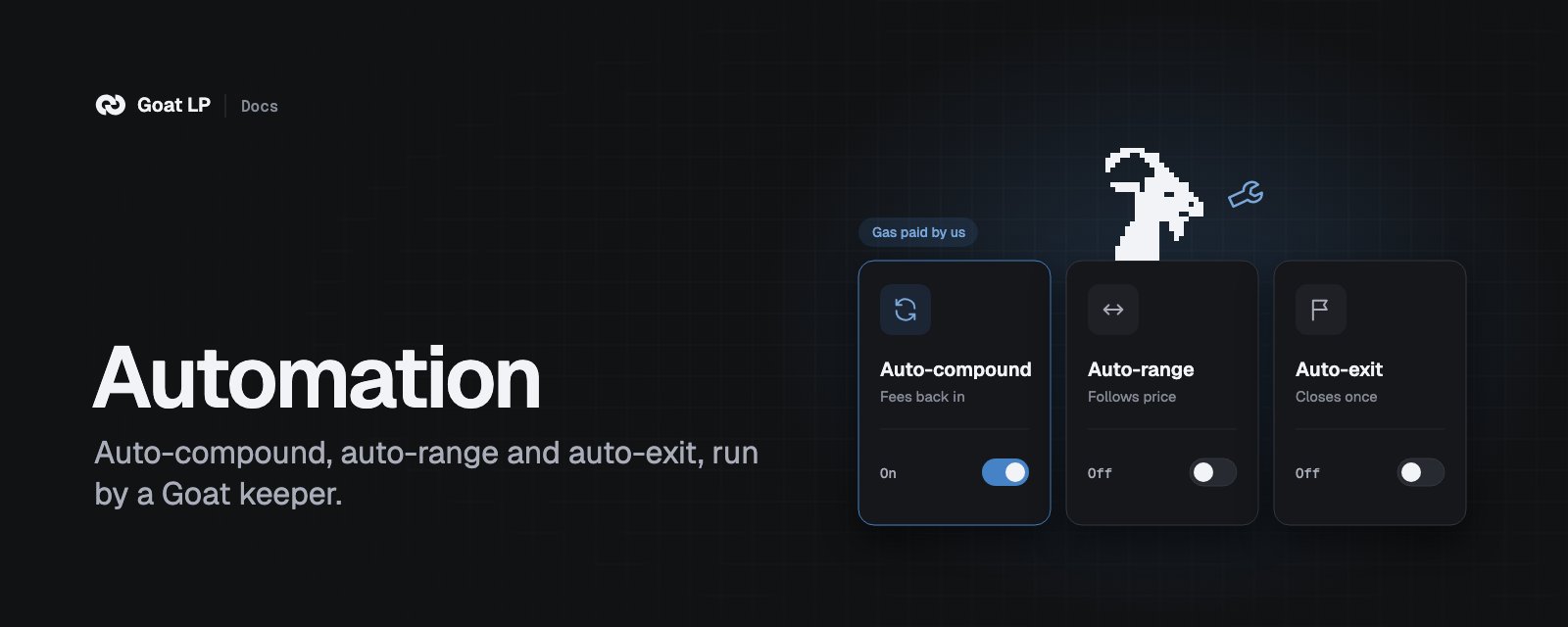
The three automations
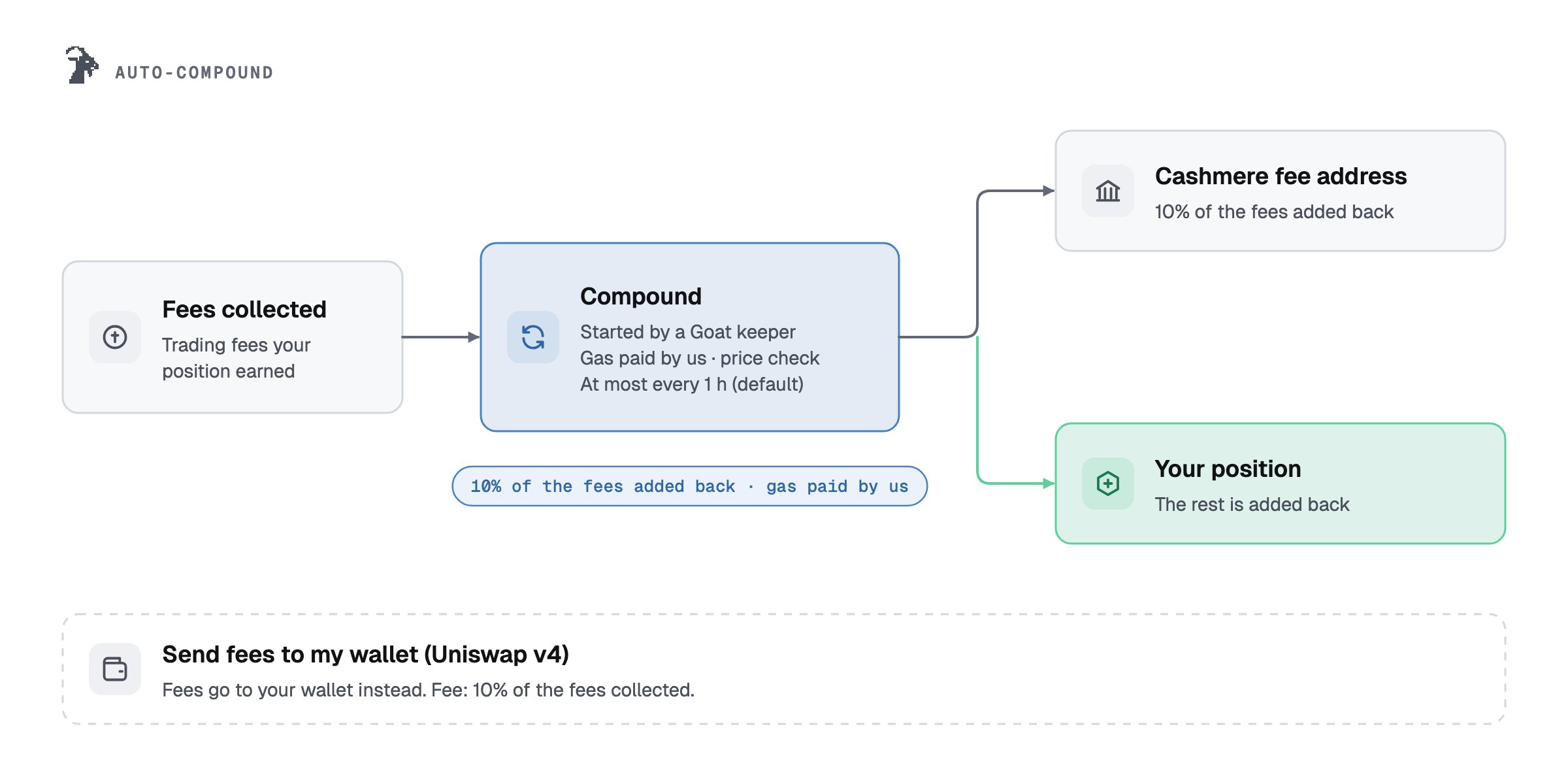
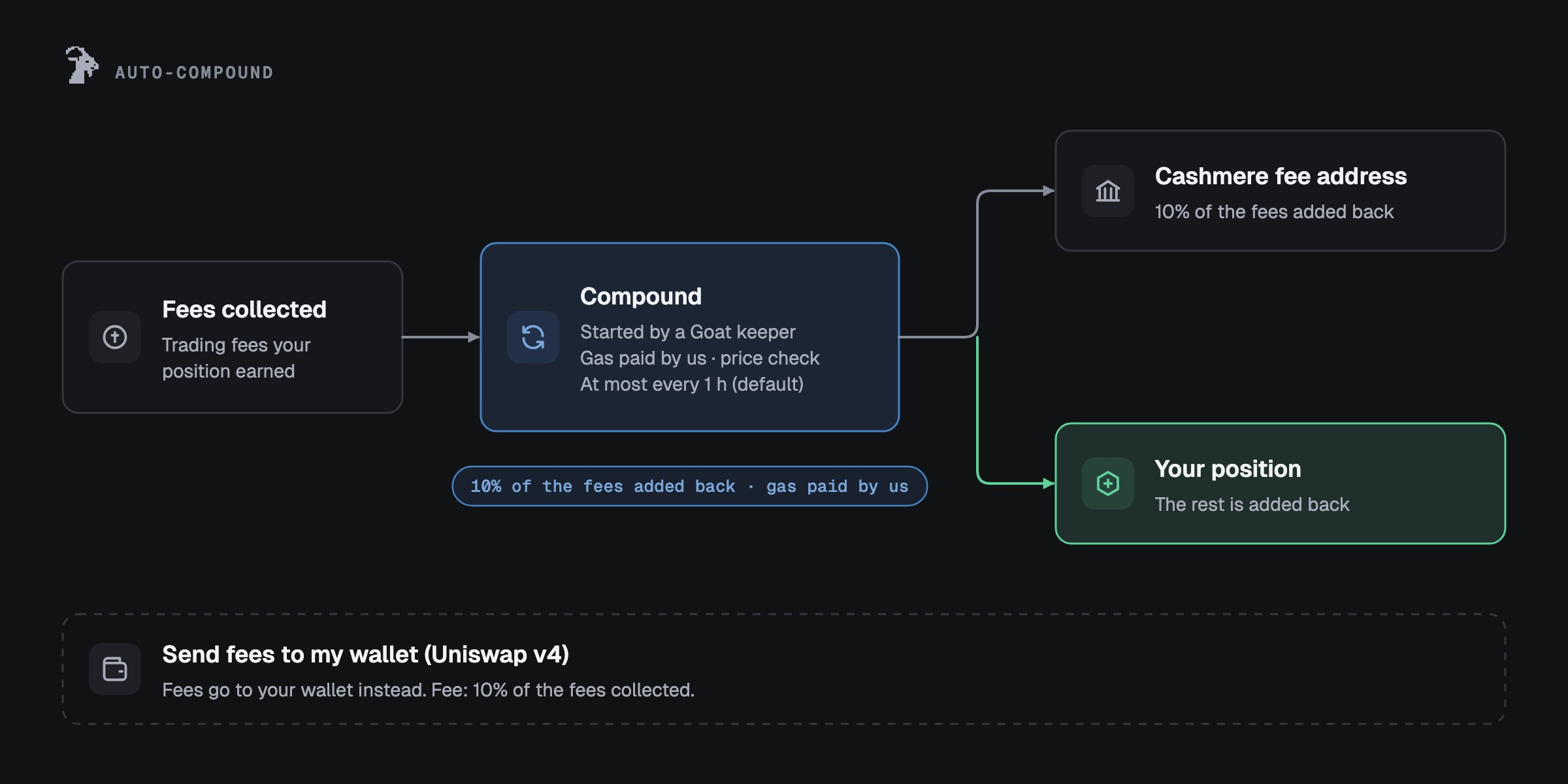
On Uniswap v4, auto-compound can also send the fees to your wallet instead of adding them back: 10% of
the fees collected, gas paid by us. The exact base of each fee is on Fees.
A position runs one automation at a time. Stop one before you start another.
How a run works
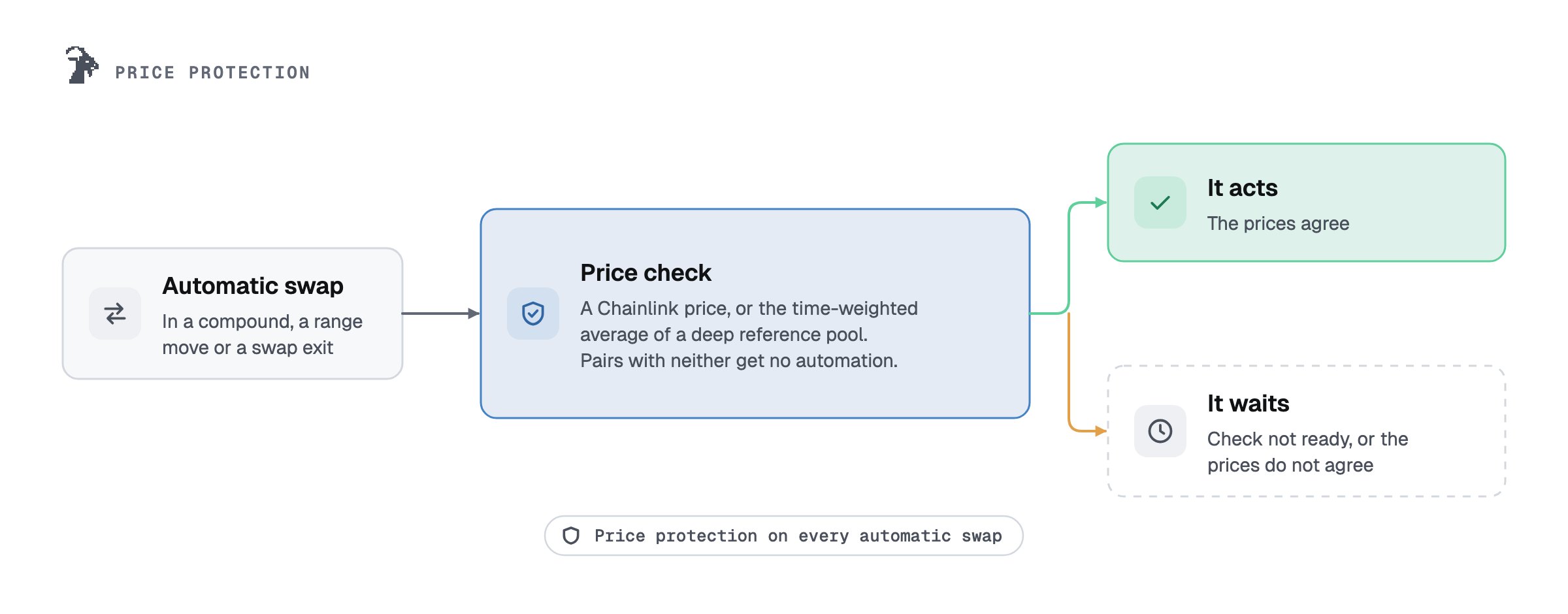
- Price check
- Auto-compound
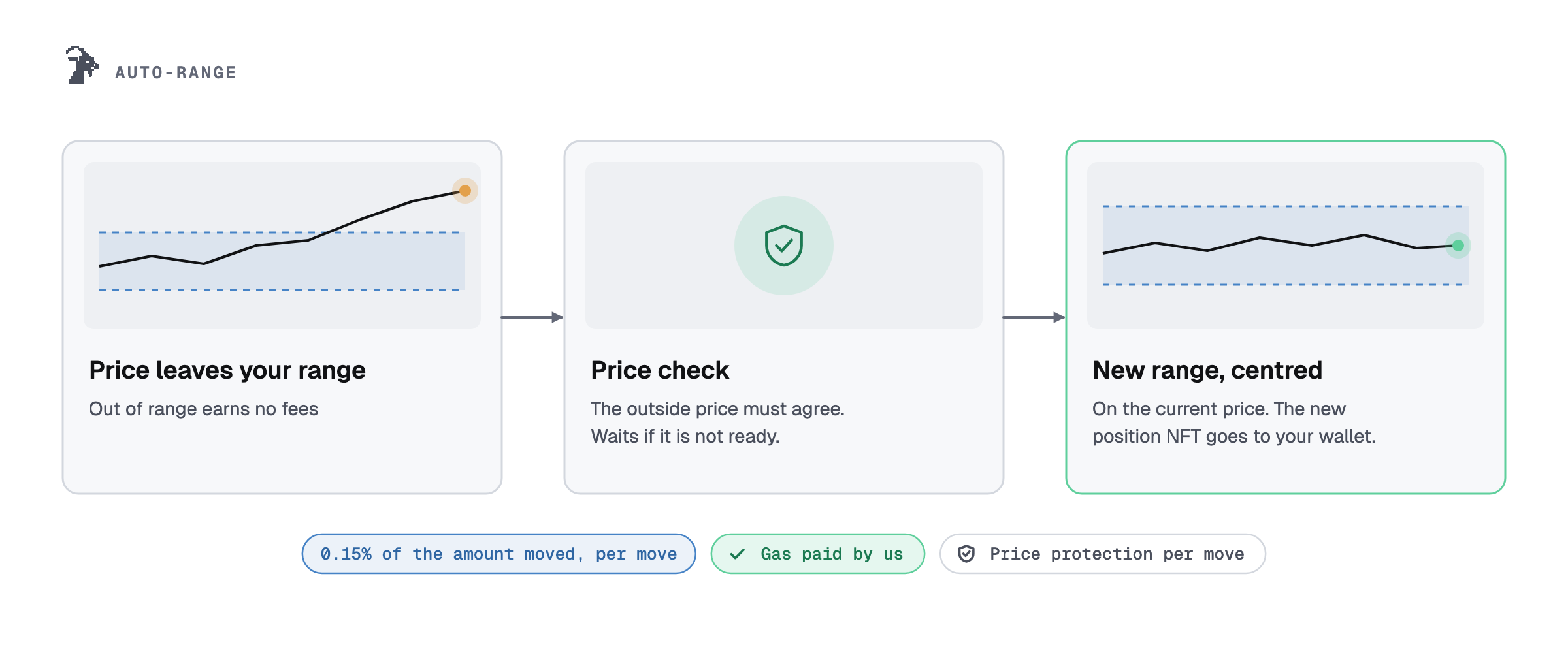
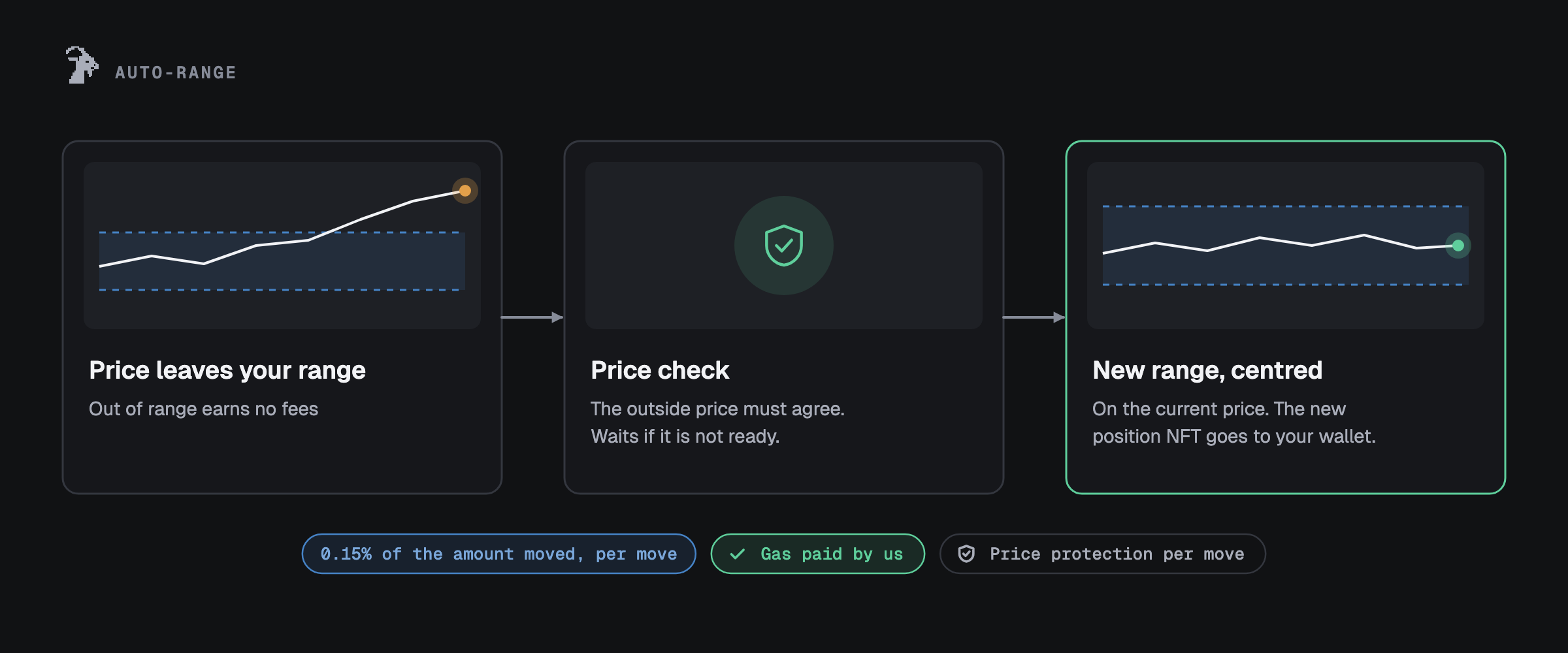
- Auto-range
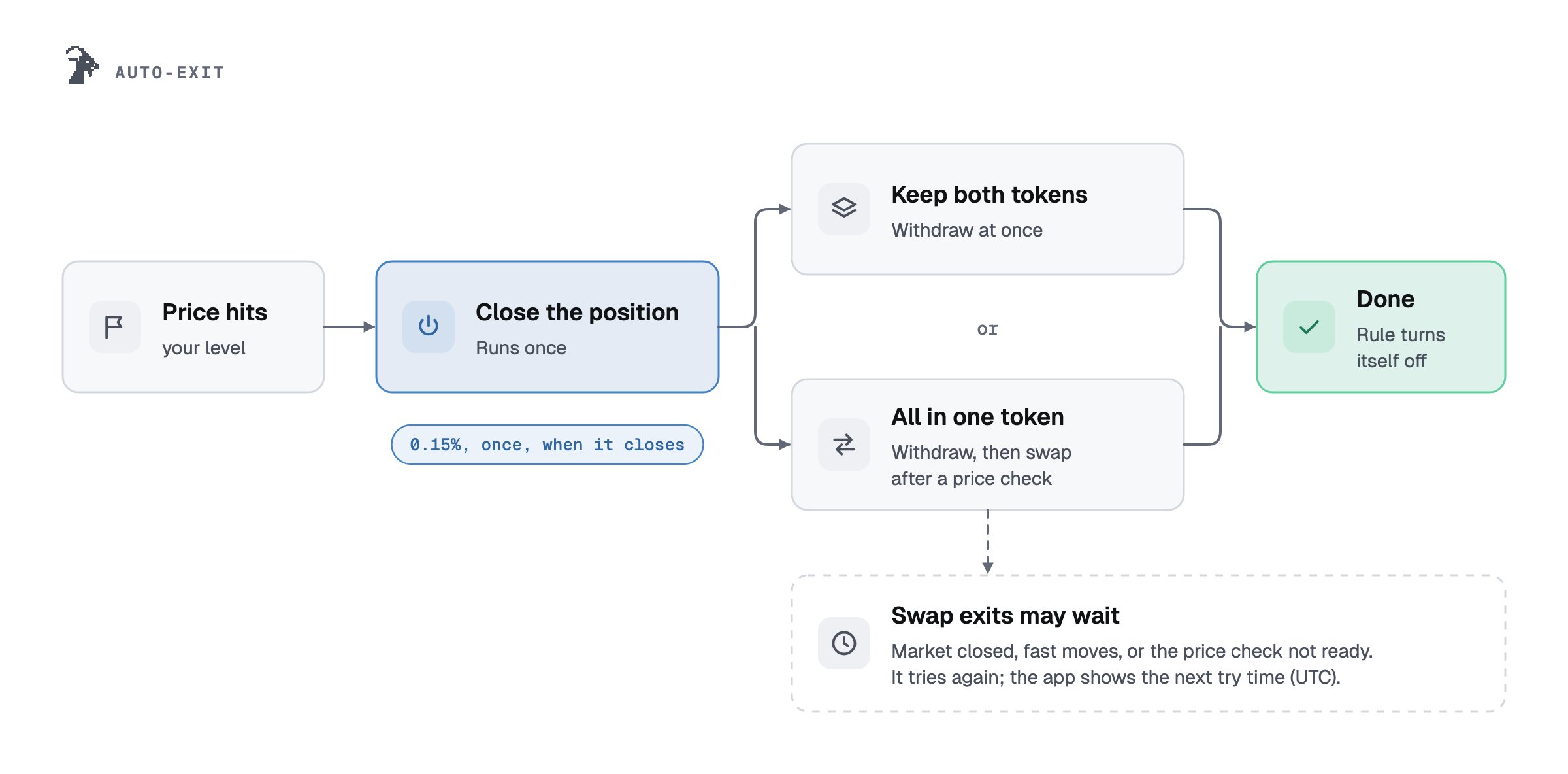
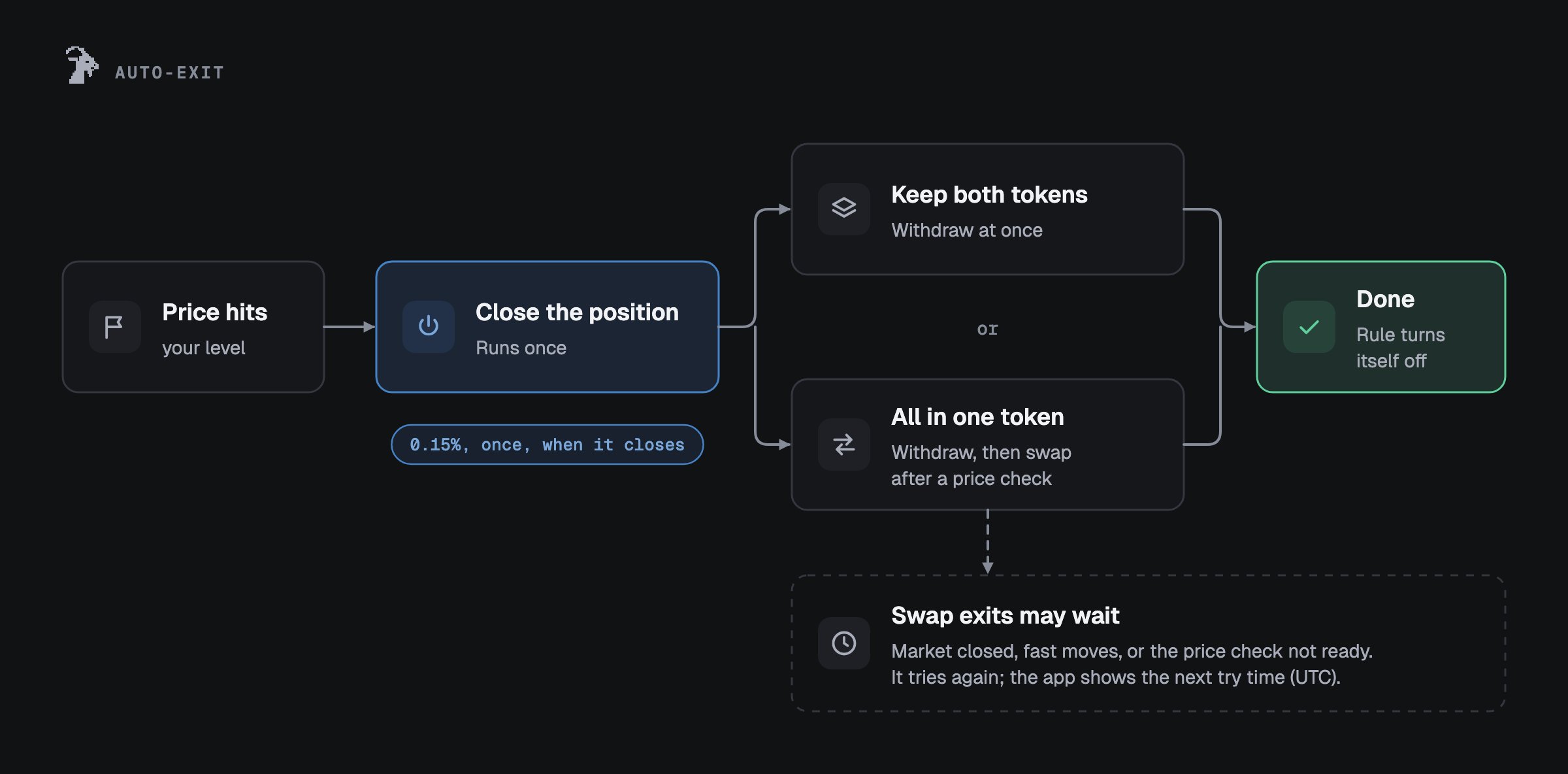
- Auto-exit
- The keeper only triggers the run. The contract decides what happens and where the money goes.
- Before any swap, the contract compares the pool price with an outside price, so one big trade in the pool cannot set off a run or push its price.
- Every output goes to the position’s owner. The keeper receives nothing.
Turn it on
1
Open the setup sheet
Press Automate on the position page and pick Auto-compound, Auto-range or Auto-exit. The
sheet says straight away if the automation cannot run on this position, and why.
2
Pick your settings
Every field starts with a default. The picture shows your range and the prices where we act. The cost
line shows Goat’s fee and that the gas is paid by us.
3
Review, then two wallet steps
Allow this position, then Turn on. Changing a rule later is one step, Save changes, and the
permission stays. Nothing is sent until you confirm in your wallet.
What you allow
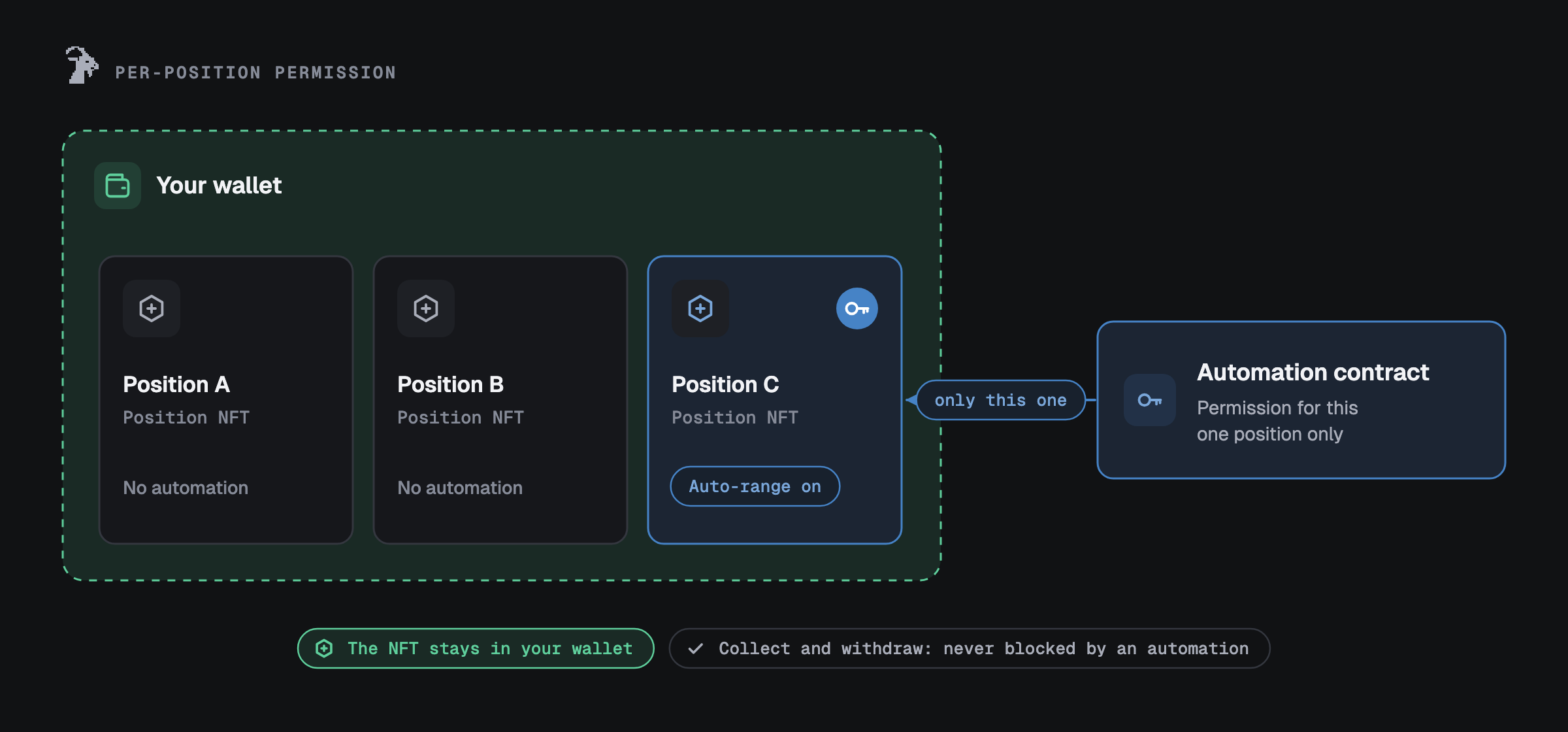
Every automation works through a permission for one position. The one exception is auto-range: you can give one permission for all your positions of one Uniswap version, see Allow for all positions.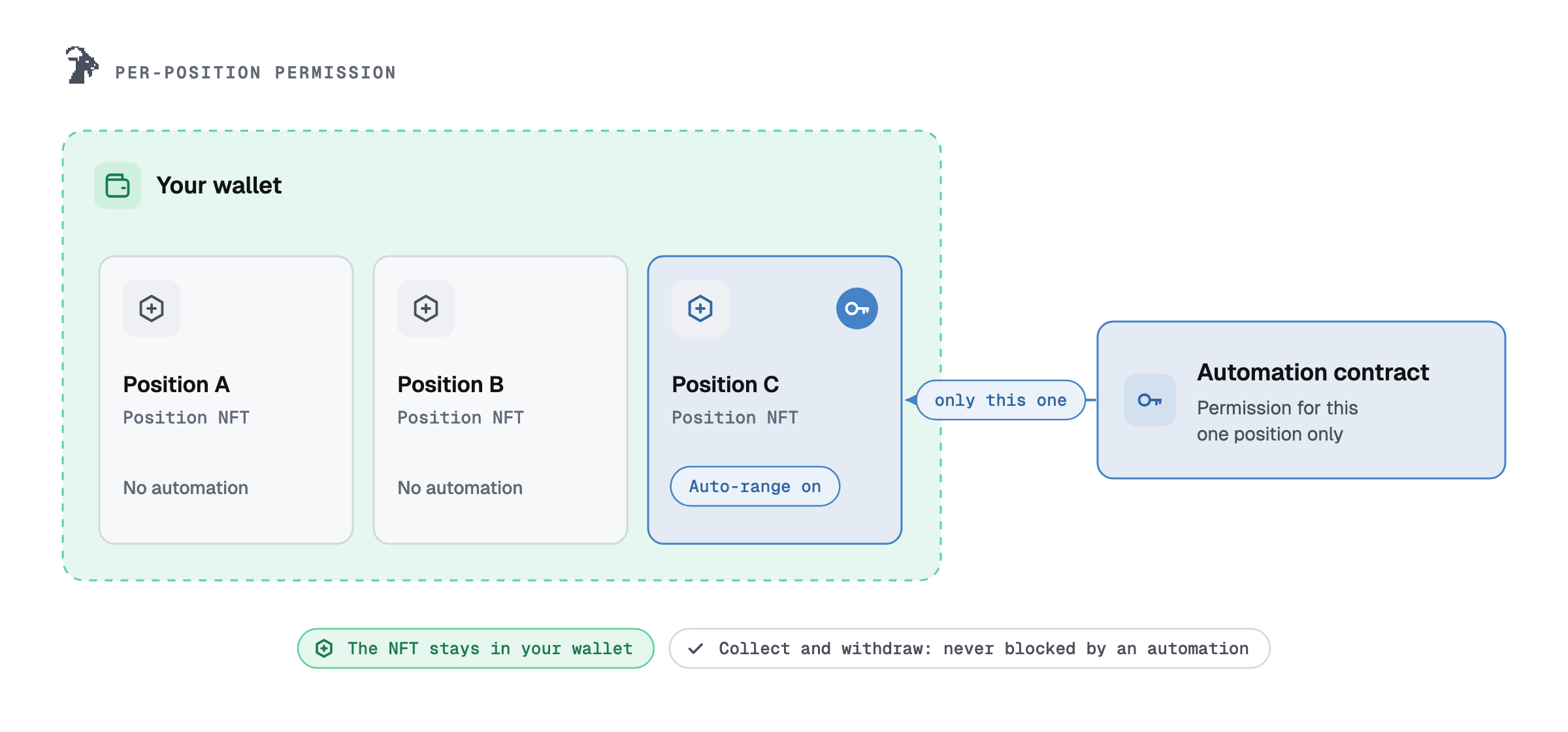
After each auto-range move the new position has a new number and needs your OK before it can move
again: Allow #new, one tap, a network fee under a cent, no Goat LP fee. Your settings move with it.
You can skip this tap with Allow for all positions.
On Uniswap v3, a manual compound, or a withdraw or collect to one token, moves the NFT through a
contract and back, which removes the permission you gave that position. If an automation is on, the app
says so before your wallet opens and adds Allow again to the same transaction (a second wallet step if
your wallet cannot batch calls).
On Uniswap v3 and v4, a permission on a position lets the allowed contract manage that position. What
limits it is the contract’s code: each Goat contract only runs the rule you set and sends every output to
the owner. The contract addresses are on Contracts.
Settings
Auto-compound
Auto-compound
- At most once every: 1 hour (default), 6 hours, 12 hours, 1 day or 7 days.
- Price protection: the most the swap may lose against the outside price (default 1%).
- Uniswap v4 mode: Add fees back (default) or Send fees to my wallet.
- Uniswap v3: Swap to match the range. Off: only the matching part is added; the rest comes back to you without a fee.
Auto-range
Auto-range
- How far past the edge before we move: at least the pair’s minimum, shown in the sheet.
- Width of each new range: on v3, same as now or custom; on v4, the same width as now.
- Price protection per move: default 0.50%.
- Uniswap v4 only: wait between moves (1 hour to 30 days, default 6 hours), the highest swap fee in a move (default 1%, at most 10%) and 20 moves before you save the rule again.
- Uniswap v3: no wait between moves.
Auto-exit
Auto-exit
- A level below your range, above it, or both. The sheet suggests 5% beyond each edge.
- Keep (withdraw only) acts as soon as the pool price reaches your level.
- Swap all to one token also checks the outside price first, so in a fast move it can wait.
- In a sudden jump the price can pass your level before we act, so you may get less than shown.
Where it can run
- Listed pairs with an outside price: a Chainlink price, or a deep pool Goat checks against. Pairs without one are not offered.
- Uniswap v4 hooks: pools without a hook, or with a hook Goat reviewed. Other hook pools get withdraw-only exits at most.
- Withdraw-only exits also work on a listed pair’s pools that have no price check of their own.
- Size: there is no per-position cap. Positions under about $50 are not offered auto-range, because a move’s fee would not cover its gas. On pairs without a Chainlink price, an hourly swap limit is shared by everyone on the pair; auto-range is not offered for a position too large for it. Auto-exit still works.
- Stock-token pairs run swaps only while their outside price is updating, so a move or a swap exit can wait a day or more.
Status and stopping
Stop turns the rule off (the keeper stops right away), then removes the permission. The sheet then
checks the chain and says “Checked on chain: the rule is off and no permission is left.” Your funds stay
in the position. Automation also stops when the position changes owner.
On a v4 auto-range rule whose trigger is reached, you can press Move now yourself: one transaction, you
pay the network fee, the 0.15% fee applies as usual.
Keepers
- Keepers are Goat-run bots. They pay the gas. They never hold or receive your tokens.
- A compound or a move runs only when Goat’s fee from it is at least 1.25 times the gas it costs, so a small position may run rarely.
- Exits run even when the fee does not cover the gas, within Goat’s daily gas limits.
- If a keeper is late or down, nothing happens to your position. Do not rely on automation as your only safety net. In the first days after the opening, keepers are switched on in stages.